安全工具- IVAgent - Multi-Agent 驱动的漏洞挖掘系统
推荐 原创【安全工具- IVAgent - Multi-Agent 驱动的漏洞挖掘系统】此文章归类为:安全工具。

IVAgent (Intelligent Vulnerability Analysis Agent) 是一个基于大语言模型(LLM)的智能漏洞挖掘系统,支持多种分析引擎和二进制/源码分析场景。
目录
核心特性
- 多引擎支持: IDA Pro (二进制)、JEB (Android)、ABC-Decompiler (HarmonyOS)、Source Code (源码)
- 递归深度分析: 基于调用链的深度漏洞挖掘,支持跨函数分析
- 约束传播: 支持污点源追踪和参数约束在调用链中的传播
- 智能调度: LLM 驱动的 Workflow 编排和任务调度
- 可视化: 完整的 Web 界面支持日志追踪、漏洞管理和 Agent 执行可视化
系统架构
IVAgent 采用分层设计,核心组件包括:
1 2 3 4 5 6 7 8 9 10 11 12 13 14 15 16 | ┌─────────────────────────────────────────────────────┐│ 用户界面层 ││ (CLI / Web UI / API) │├─────────────────────────────────────────────────────┤│ 编排调度层 ││ (Orchestrator / Task Manager / Workflow Parser) │├─────────────────────────────────────────────────────┤│ 智能分析层 ││ (DeepVulnAgent / FunctionSummaryAgent / ...) │├─────────────────────────────────────────────────────┤│ 引擎抽象层 ││ (IDA Engine / JEB Engine / Source Engine / ...) │├─────────────────────────────────────────────────────┤│ 数据存储层 ││ (Vuln Storage / Log Storage / Cache) │└─────────────────────────────────────────────────────┘ |
项目结构
1 2 3 4 5 6 7 8 9 10 11 12 13 14 15 16 17 18 19 20 21 22 23 24 25 26 27 28 29 30 31 32 33 34 35 36 37 38 39 40 41 42 43 44 45 46 47 48 49 | ivas/├── ivagent/ # 核心包│ ├── agents/ # Agent 实现│ │ ├── deep_vuln_agent.py # 深度漏洞挖掘 Agent (核心)│ │ ├── callsite_agent.py # 调用点解析 Agent│ │ ├── function_summary_agent.py # 函数摘要 Agent│ │ └── prompts.py # 提示词模板│ ├── backends/ # 后端适配器│ │ ├── ida/ # IDA Pro 适配器│ │ ├── jeb/ # JEB 适配器│ │ └── abc_decompiler/ # ABC 反编译器适配器│ ├── core/ # 核心组件│ │ ├── llm_logger.py # LLM 调用日志│ │ ├── agent_logger.py # Agent 执行日志│ │ ├── vuln_storage.py # 漏洞存储│ │ └── tool_llm_client.py # Tool Call 客户端│ ├── engines/ # 分析引擎│ │ ├── base_static_analysis_engine.py # 引擎基类│ │ ├── ida_engine.py # IDA 引擎│ │ ├── jeb_engine.py # JEB 引擎│ │ ├── abc_engine.py # ABC 引擎│ │ ├── source_code_engine.py # 源码引擎│ │ └── factory.py # 引擎工厂│ ├── models/ # 数据模型│ │ ├── constraints.py # 约束和上下文│ │ ├── vulnerability.py # 漏洞模型│ │ └── workflow.py # Workflow 模型│ ├── orchestrator/ # 任务编排│ │ ├── orchestrator_agent.py # 编排 Agent│ │ ├── workflow_parser.py # Workflow 解析器│ │ └── tools.py # 编排工具集│ ├── scanner.py # 扫描器主类│ └── web/ # Web 界面│ ├── server.py # Web 服务器│ ├── api.py # REST API│ └── static/ # 静态资源├── preconditions/ # 预置条件配置│ ├── _template.md # 模板│ ├── android.md # Android 入口分析│ ├── binary.md # 二进制分析│ └── harmony.md # HarmonyOS 分析├── workflows/ # Workflow 定义│ ├── android_sql_injection.md│ ├── arkts_ability_hijack.md│ └── rpc_server_analysis.md├── ivagent_scan.py # 扫描 CLI├── orchestrator_cli.py # Workflow CLI├── launch_web.py # Web 启动器└── start_ida_rpc.py # IDA RPC 启动器 |
快速开始
安装依赖
1 | pip install -r requirements.txt |
环境配置
1 2 3 | export OPENAI_API_KEY="your-api-key"export OPENAI_BASE_URL="0d8K9s2c8@1M7s2y4Q4x3@1q4Q4x3V1k6Q4x3V1k6S2M7r3W2Q4x3X3g2G2M7r3g2F1j5h3W2Q4x3X3g2U0L8$3#2Q4x3V1k6$3x3b7`.`." # 可选export OPENAI_MODEL="gpt-4" # 可选 |
启动 IDA RPC 服务器(如使用 IDA 引擎)
1 2 | # 在 IDA Pro 中加载 IDB 后运行python start_ida_rpc.py --idb /path/to/binary.i64 --port 9999 |
配置 ABC-Decompiler 引擎(HarmonyOS 应用分析)
ABC-Decompiler 用于分析 HarmonyOS 应用的 ABC 文件,基于 Jadx 的 MCP 插件实现。
架构流程:
1 | IVAgent → AbcDecompilerClient → MCP Server → Jadx AI MCP Plugin → ABC 文件 |
配置步骤:
安装 Jadx AI MCP 插件
1# bf9K9s2c8@1M7s2y4Q4x3@1q4Q4x3V1k6Q4x3V1k6Y4K9i4c8Z5N6h3u0Q4x3X3g2U0L8$3#2Q4x3V1k6E0j5h3N6A6j5$3I4X3i4K6u0V1j5h3W2Q4x3V1k6S2j5X3y4Q4x3X3c8V1k6h3y4G2L8i4m8A6L8r3g2J5i4K6u0V1L8h3y4H3启动 MCP 服务端
12345# 进入服务端脚本目录cdivagent/backends/abc_decompiler/server_scripts# 启动 MCP Server(HTTP 模式)python jadx_mcp_server.py --http --port 8651 --jadx-port 8650参数说明:
--http: 启用 HTTP 传输模式--port: MCP Server 监听端口(默认 8651)--jadx-port: Jadx AI MCP Plugin 端口(默认 8650)
在 ABC-Decompiler 中加载 ABC 文件
- 打开 ABC-Decompiler
- 加载要分析的
.abc文件 - 确保 AI MCP Plugin 已启用并连接到端口 8650
测试连接
12# 服务端启动后会显示健康检查结果# Health check result: {"status": "ok"}
配置 JEB 引擎(Android 应用分析)
JEB 引擎用于分析 Android APK 文件,通过 JSON-RPC 协议与 JEB 进程通信。
架构流程:
1 | IVAgent → JEBClient → HTTP JSON-RPC → JEB RPC Server (MCP.py) → JEB Decompiler → APK |
配置步骤:
准备 JEB 环境
- 确保 JEB 已安装并可正常运行
- 需要 JEB 的脚本执行权限
启动 JEB RPC 服务
方式一:通过 JEB 控制台加载脚本
123# 在 JEB 中打开 APK 文件# 然后执行脚本:File → Scripts → Execute Script# 选择:ivagent/backends/jeb/server_scripts/MCP.py方式二:设置环境变量(守护模式)
123456# 启用守护模式exportJEB_MCP_DAEMON=1exportJEB_MCPC_HOST=127.0.0.1exportJEB_MCPC_PORT=16161# 然后在 JEB 中执行 MCP.py 脚本验证服务启动
- 脚本执行后会在控制台输出:
[MCP] Server started at 642K9s2c8@1M7q4)9K6b7g2)9J5c8W2)9J5c8U0p5J5y4#2)9J5k6e0m8Q4x3X3f1H3i4K6u0W2x3g2)9K6b7e0p5$3x3e0j5I4 - 服务默认监听端口 16161
- 脚本执行后会在控制台输出:
环境变量配置:
| 变量名 | 说明 | 默认值 |
|---|---|---|
JEB_MCPC_HOST |
RPC Server 监听地址 | 127.0.0.1 |
JEB_MCPC_PORT |
RPC Server 监听端口 | 16161 |
JEB_MCP_DAEMON |
是否启用守护模式 | 0 |
使用方式
IVAgent 提供两种主要使用方式:
- 直接扫描模式 (
ivagent_scan.py): 针对指定函数进行深度漏洞分析 - Workflow 编排模式 (
orchestrator_cli.py): LLM 驱动的自动化任务编排
方式一:直接扫描指定函数
使用 ivagent_scan.py 对单个或多个函数进行漏洞扫描。
基础用法
IDA 引擎(二进制分析):
1 2 3 4 5 6 | # 扫描单个函数python ivagent_scan.py \ -e ida \ -t /path/to/binary.i64 \ -f "sub_140001000" \ --preset binary |
JEB 引擎(Android APK 分析):
1 2 3 4 5 6 7 8 9 10 11 12 13 14 15 16 17 | # 确保 JEB RPC 服务已启动(端口 16161)# 扫描 Android 应用的特定方法python ivagent_scan.py \ -e jeb \ -t /path/to/app.apk \ -f "Lcom/example/MainActivity;->onCreate" \ --preset android# 指定自定义端口python ivagent_scan.py \ -e jeb \ -t /path/to/app.apk \ --host 127.0.0.1 \ --port 16161 \ -f "Lcom/example/LoginActivity;->checkLogin" \ --preset android |
ABC-Decompiler 引擎(HarmonyOS 应用分析):
1 2 3 4 5 6 7 8 9 10 11 12 13 14 15 | # 确保 MCP Server 已启动(端口 8651)# 扫描 HarmonyOS 应用的方法python ivagent_scan.py \ -e abc \ -t /path/to/app.abc \ -f "com.example.EntryAbility.onCreate" \ --preset harmony# 指定自定义 MCP Server URLpython ivagent_scan.py \ -e abc \ --host "602K9s2c8@1M7q4)9K6b7g2)9J5c8W2)9J5c8U0p5J5y4#2)9J5k6e0m8Q4x3X3f1H3i4K6u0W2x3g2)9K6b7e0R3$3y4e0q4Q4x3V1k6E0j5%4l9`." \ -f "com.example.MyAbility.parseData" \ --preset harmony |
参数说明
| 参数 | 说明 | 示例 |
|---|---|---|
-e, --engine |
分析引擎类型 (ida/jeb/abc/source) | -e ida |
-t, --target |
目标文件路径 | -t app.apk |
-f, --function |
要扫描的函数签名或地址 | -f "sub_140001000" |
--host |
引擎 RPC 主机地址 | --host 127.0.0.1 |
--port |
引擎 RPC 端口 | --port 9999 |
--preset |
使用预置 Precondition | --preset binary |
--config |
自定义 Precondition 配置文件 | --config my_config.md |
-c, --concurrency |
最大并发数 | -c 5 |
-o, --output |
输出结果文件 (JSON) | -o results.json |
--source-root |
源码根目录(用于源码分析) | --source-root /path/to/src |
使用 Precondition 配置
Precondition 用于描述目标函数的已知约束,帮助 Agent 更精准地分析:
1 2 3 4 5 | # 使用预置配置python ivagent_scan.py -e ida -t driver.i64 -f "parse_input" --preset binary# 使用自定义配置文件python ivagent_scan.py -e ida -t driver.i64 -f "parse_input" --config ./my_precondition.md |
内置 preset 包括:
binary: 二进制解析函数分析android: Android 入口点分析harmony: HarmonyOS 应用分析
Precondition 配置示例
---
name: Binary Parser Function
description: 二进制解析函数的安全分析配置
target: binary_parser
taint_sources:
  - "param1"
---

## 参数说明

### 第一个参数
- 指向攻击者控制的数据缓冲区

### 第二个参数
- 数据长度(可能由攻击者指定)

## 常见风险点

- 长度验证缺失或不当
- 整数溢出(长度计算)
- 缓冲区溢出
方式二:Workflow 编排分析
使用 orchestrator_cli.py 通过 Workflow 文档描述分析意图,由 LLM 自主规划执行。
基础用法
源码分析模式:
1 2 3 4 5 | python orchestrator_cli.py \ --workflow workflows/android_sql_injection.md \ --engine source \ --target /path/to/source \ --source-root /path/to/source |
IDA 引擎 + Workflow:
1 2 3 4 | python orchestrator_cli.py \ --workflow workflows/rpc_server_analysis.md \ --engine ida \ --target /path/to/binary.i64 |
JEB 引擎 + Workflow(Android 分析):
1 2 3 4 5 6 7 | # 确保 JEB RPC 服务已启动python orchestrator_cli.py \ --workflow workflows/android_sql_injection.md \ --engine jeb \ --target /path/to/app.apk \ --source-root /path/to/source |
ABC-Decompiler 引擎 + Workflow(HarmonyOS 分析):
1 2 3 4 5 6 | # 确保 MCP Server 已启动python orchestrator_cli.py \ --workflow workflows/arkts_ability_hijack.md \ --engine abc \ --target /path/to/app.abc |
参数说明
| 参数 | 说明 | 示例 |
|---|---|---|
-w, --workflow |
Workflow 文档路径(必需) | --workflow workflows/test.md |
-e, --engine |
分析引擎类型 (ida/jeb/source) | -e source |
-t, --target |
目标程序路径 | -t /path/to/source |
-s, --source-root |
源代码根目录 | -s /path/to/src |
-v, --verbose |
详细日志输出 | -v |
-q, --quiet |
静默模式 | -q |
Workflow 文档格式
Workflow 使用 Markdown 描述分析意图:
---
name: "Android SQL 注入漏洞挖掘"
description: 针对 Android 应用的 SQL 注入分析
version: "1.0"
---

## 分析范围

重点关注 ContentProvider 和数据库操作代码

## 工作流

1. 搜索可能的 ContentProvider
2. 分析对外暴露的回调函数
3. 对暴露接口开展漏洞挖掘

## 漏洞关注点

- rawQuery 的参数拼接
- execSQL 的动态 SQL 构造
启动 Web 可视化界面
1 2 | python launch_web.py# 访问 http://localhost:8080 |
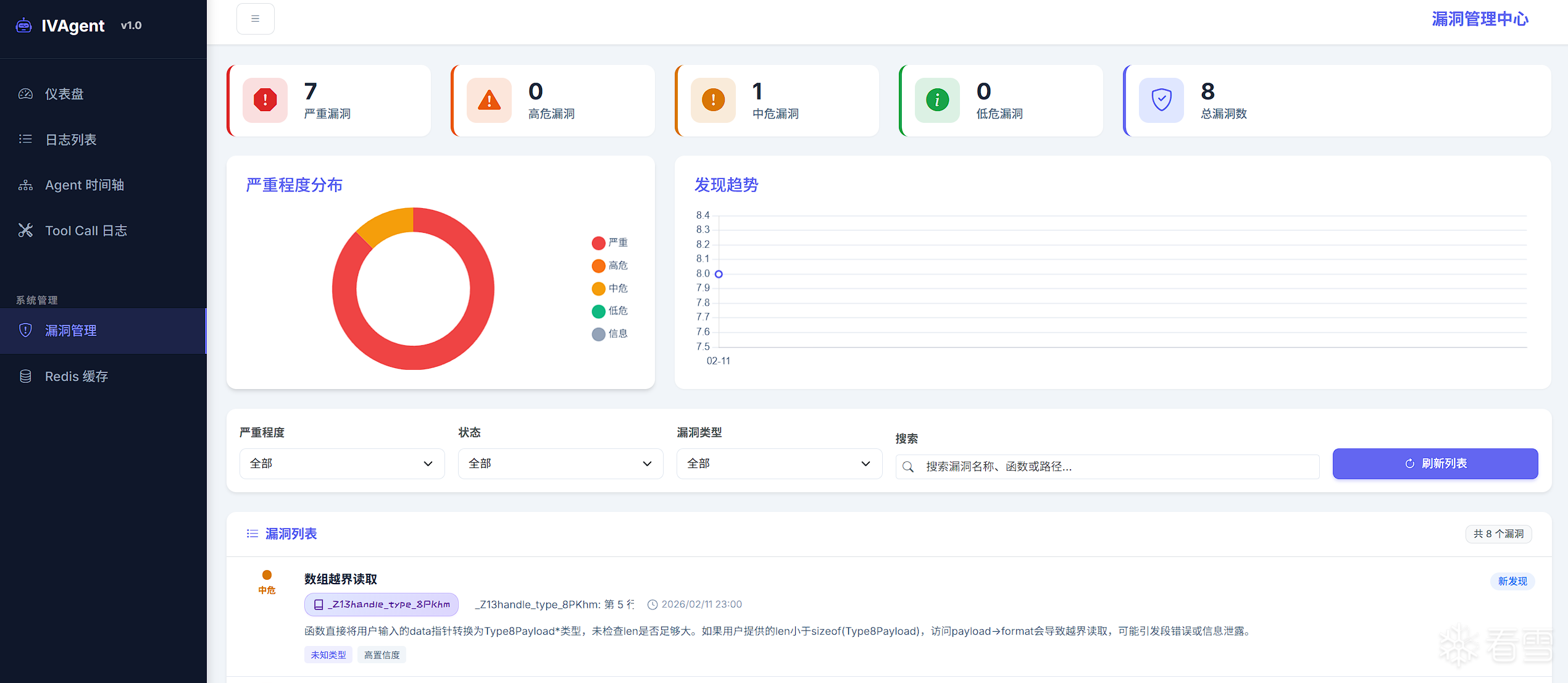
Web 界面功能:
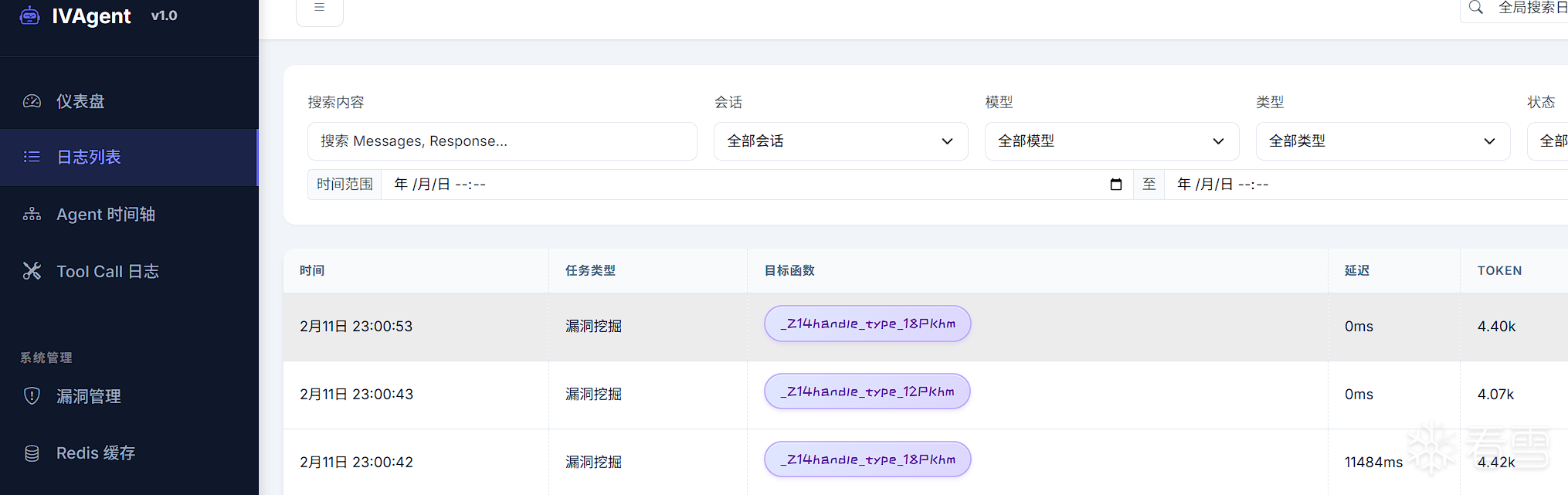
- 日志查询: 查看 LLM 调用日志、支持筛选和搜索
- Agent 追踪: 可视化 Agent 执行树和调用链
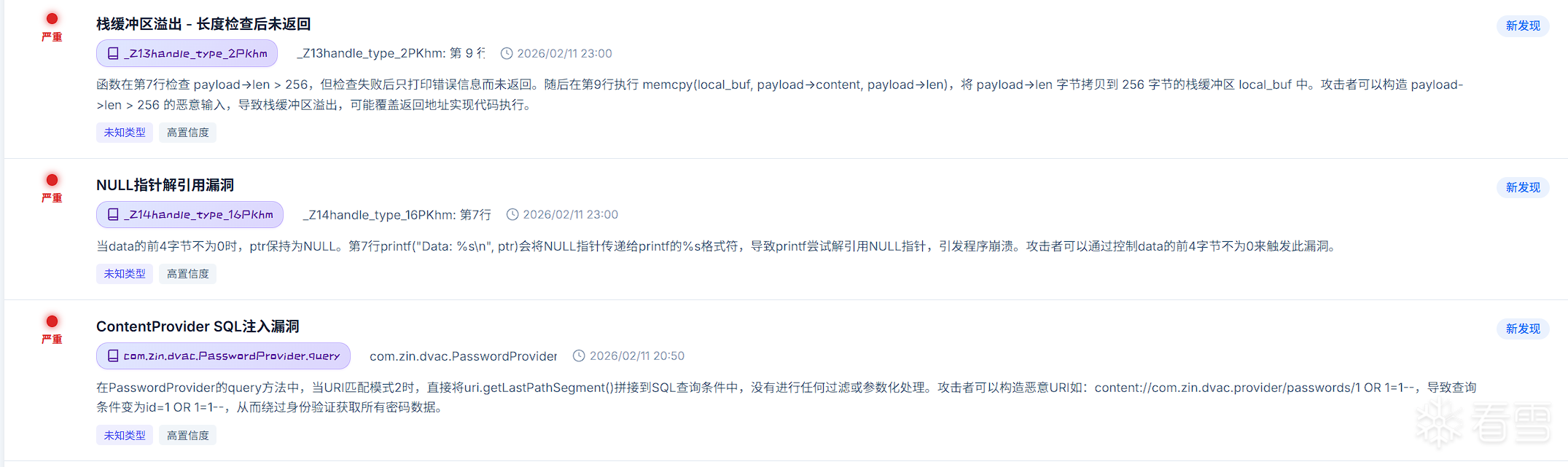
- 漏洞管理: 漏洞列表、详情、统计和状态管理
- Tool Call 分析: 查看工具调用详情和统计
- 实时推送: WebSocket 实时更新
llm 日志交互
漏洞信息
核心概念
1. DeepVulnAgent - 深度漏洞挖掘
系统的核心 Agent,采用多轮对话和 Tool Call 机制:
Tool Call 机制: LLM 通过调用工具主动获取信息
1 2 3 4 5 6 7 8 9 10 | 第 1 轮: 提供完整上下文(函数代码、调用点、约束条件) ↓LLM 分析 → Tool Call 请求(获取子函数摘要 / 创建子 Agent) ↓第 2 轮: 返回 Tool 执行结果 ↓LLM 继续分析 → 可能发现漏洞或继续深入 ↓...第 N 轮: finalize_analysis_tool 结束分析 |
主要工具:
get_function_summary_tool: 获取子函数摘要create_sub_agent_tool: 创建子 Agent 深入分析report_vulnerability_tool: 报告发现的漏洞finalize_analysis_tool: 完成分析
2. 分析引擎 (Engine)
统一的引擎接口支持多种后端:
1 2 3 4 5 6 7 8 9 10 11 12 13 14 | from ivagent.engines.factory import create_engineengine = create_engine( "ida", target_path="/path/to/binary.i64", host="127.0.0.1", port=9999)# 获取函数定义func_def = await engine.get_function_def(function_identifier="sub_140001000")# 获取调用点sites = await engine.get_callee(function_identifier) |
3. 约束传播机制
在跨函数分析中,约束传播是关键:
1 2 3 4 5 6 7 8 9 10 11 | # 父函数发现约束父函数: process_input(buf, size) ↓ 调用子函数: memcpy(dst, src, len) # 传播约束到子函数argument_constraints = [ "src 指向用户可控数据(污点)", "len 最大为 1024 字节", "dst 是局部缓冲区,大小 256 字节"] |
约束以纯文本格式传播,降低了对 LLM 的结构化输出要求。
配置说明
环境变量
LLM 配置
| 变量名 | 说明 | 默认值 |
|---|---|---|
OPENAI_API_KEY |
LLM API Key | - |
OPENAI_BASE_URL |
API 基础 URL | - |
OPENAI_MODEL |
模型名称 | gpt-4 |
LLM_LOG_STORAGE |
日志存储类型 (sqlite/memory) | sqlite |
JEB 引擎配置
| 变量名 | 说明 | 默认值 |
|---|---|---|
JEB_MCPC_HOST |
RPC Server 监听地址 | 127.0.0.1 |
JEB_MCPC_PORT |
RPC Server 监听端口 | 16161 |
JEB_MCP_DAEMON |
是否启用守护模式 (1/0) | 0 |
引擎连接参数
| 引擎 | 参数 | 说明 | 默认值 |
|---|---|---|---|
| IDA | host |
RPC Server 地址 | 127.0.0.1 |
| IDA | port |
RPC Server 端口 | 9999 |
| JEB | host |
RPC Server 地址 | 127.0.0.1 |
| JEB | port |
RPC Server 端口 | 16161 |
| JEB | timeout |
连接超时(秒) | 120 |
| ABC | host |
MCP Server 完整 URL | be4K9s2c8@1M7q4)9K6b7g2)9J5c8W2)9J5c8U0p5J5y4#2)9J5k6e0m8Q4x3X3f1H3i4K6u0W2x3g2)9K6b7e0R3$3y4e0q4Q4x3V1k6E0j5%4l9`. |
| Source | source_root |
源代码根目录 | - |
API 参考
扫描器 API
1 2 3 4 5 6 7 8 9 10 11 12 | from ivagent.scanner import IVAgentScanner, ScanConfigconfig = ScanConfig( engine_type="ida", target_path="/path/to/binary.i64", llm_api_key="your-key", llm_model="gpt-4", max_concurrency=10)scanner = IVAgentScanner(config)results = await scanner.scan_functions(["func1", "func2"], precondition) |
编排器 API
1 2 3 4 5 6 7 8 9 | from ivagent.orchestrator import TaskOrchestratorAgentorchestrator = TaskOrchestratorAgent( llm_client=llm, engine_type="ida", target_path="/path/to/binary")result = await orchestrator.execute_workflow("workflows/analysis.md") |
漏洞输出格式
{
  "vulnerabilities": [
    {
      "type": "BUFFER_OVERFLOW",
      "name": "缓冲区溢出",
      "description": "函数使用 memcpy 时未检查长度",
      "location": "sub_140001000: 第 15 行",
      "severity": 0.9,
      "confidence": 0.8,
      "data_flow": {
        "source": "用户输入",
        "sink": "局部缓冲区",
        "path_description": "污点传播路径"
      },
      "remediation": "添加长度检查",
      "metadata": {
        "call_stack": ["main", "process_input", "sub_140001000"],
        "evidence": ["代码证据行"]
      }
    }
  ]
}
扩展开发
添加新的分析引擎
继承 BaseStaticAnalysisEngine:
1 2 3 4 5 6 7 8 9 10 11 12 13 14 | from ivagent.engines.base_static_analysis_engine import BaseStaticAnalysisEngineclass MyEngine(BaseStaticAnalysisEngine): async def get_function_def(self, function_identifier, **kwargs): # 实现获取函数定义 pass async def get_callee(self, function_identifier): # 实现获取子函数调用 pass async def _resolve_static_callsite(self, callsite, caller_identifier): # 实现调用点解析 pass |
添加新的 Agent
继承 BaseAgent:
1 2 3 4 5 6 | from ivagent.agents.base import BaseAgentclass MyAgent(BaseAgent): async def run(self, **kwargs) -> Dict[str, Any]: # 实现 Agent 逻辑 pass |
性能优化
并发控制
1 2 3 4 5 6 | # 使用信号量控制并发semaphore = asyncio.Semaphore(max_concurrency)async def _scan_single(idx, sig): async with semaphore: return await agent.run(sig) |
请求去重
1 2 3 4 | # 避免重复请求相同函数摘要if func_name in requested_summaries: continuerequested_summaries.add(func_name) |
缓存机制
- 函数定义缓存
- 函数摘要缓存
- LLM 响应缓存
局限性与改进方向
当前局限
- LLM 成本: 大规模分析时 API 调用成本较高
- 响应延迟: LLM 调用有几百毫秒到数秒的延迟
- 上下文限制: 长函数代码可能超出 LLM 上下文窗口
- 幻觉问题: LLM 可能产生不准确的分析结果
改进方向
- 本地模型支持: 集成开源 LLM 降低使用成本
- 增量分析: 只分析修改的函数,利用历史结果
- RAG 增强: 结合向量数据库存储和检索安全知识
- 多模型集成: 使用多个模型投票减少幻觉
参考
- LangChain - LLM 应用框架
- IDA Pro - 交互式反汇编器
- JEB Decompiler - Android 反编译器
- abc-decompiler
- aixcc-afc-atlantis
贡献指南
欢迎贡献代码、报告问题或提出改进建议!
抛砖引玉,在这个 AI 时代,希望找些同路人一起探索 !

更多【安全工具- IVAgent - Multi-Agent 驱动的漏洞挖掘系统】相关视频教程:www.yxfzedu.com
相关文章推荐
- 编程技术-Python标准库有哪些 - 其他
- 编程技术-读取W25Q64的设备ID时输出0xff - 其他
- 金融-可以写进简历的软件测试项目(银行/金融/电商/商城......) - 其他
- 百度-想要创建百度百科词条怎么做? - 其他
- c#-C#基于inpoutx64读写ECRAM硬件信息 - 其他
- java-JavaScript如何实现钟表效果,时分秒针指向当前时间,并显示当前年月日,及2024春节倒计时,源码奉上 - 其他
- c++-Linux驱动应用层与内核层之间的数据传递 - 其他
- 人工智能-读书笔记:彼得·德鲁克《认识管理》第11章 若干例外及经验教训 - 其他
- 运维-短时间不点击云服务器,自动化断开连接,怎么设置长时间 - 其他
- 运维-Rocky Linux 配置邮件发送 - 其他
- 编程技术-数码管动态扫描 - 其他
- 编程技术-编程语言的基本元素 - 其他
- pandas-人工智能基础——python:Pandas与数据处理 - 其他
- 编程技术-2、鸿蒙开发工具首次运行时开发环境配置 - 其他
- 编程技术-WEB代码审计 - 其他
- 编程技术-苹果开发者证书生成实操流程 - 其他
- 运维-如何申请QQ邮箱的SMTP密钥简洁版 - 其他
- 算法-1049. 最后一块石头的重量 II - 其他
- python-根据json生成Java类 - 其他
- 运维-支撑企业数字化经营,《2023指标平台白皮书》正式发布 - 其他
2):严禁色情、血腥、暴力
3):严禁发布任何形式的广告贴
4):严禁发表关于中国的政治类话题
5):严格遵守中国互联网法律法规
6):有侵权,疑问可发邮件至service@yxfzedu.com